
HS Code for Bearings: The Complete 8482 Classification Guide
A working guide to HS heading 8482 for ball and roller bearings — subheadings, the bushing trap, and how to check your classification before customs does.
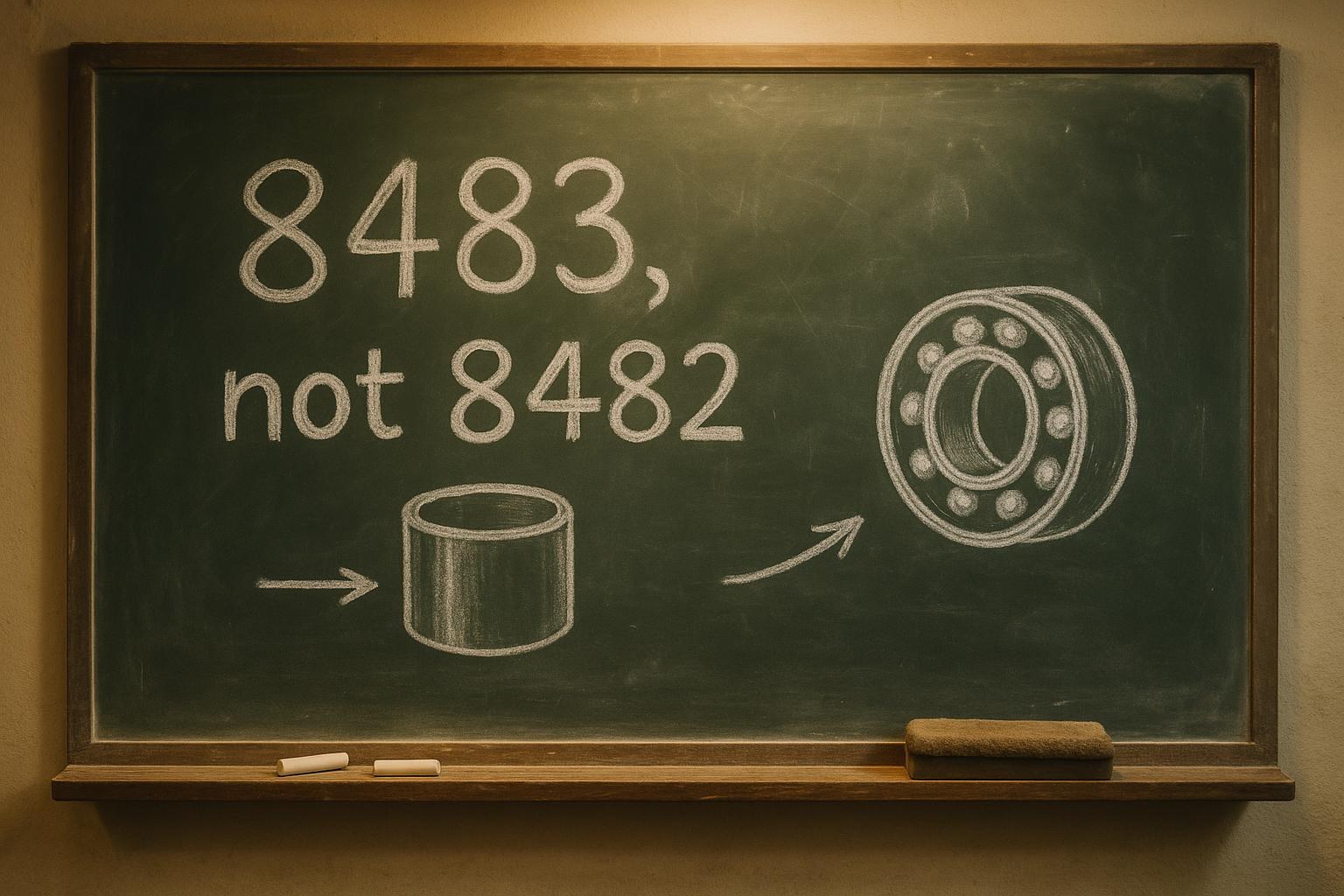
If you're moving bearings and you've typed "hs code for bearings" into a search bar more than once, you already know the problem: the answer isn't one code. It's a heading with eight subheadings, a structural test that trips up experienced classifiers, and a neighbouring heading (8483) that quietly absorbs the parts that look like bearings but aren't. Here's the whole thing, laid out so you can classify a shipment without guessing.
What heading 8482 actually is
Heading 8482 in the Harmonized System covers ball or roller bearings — full stop, that's the scope. Not all bearing-shaped components. Just the ones that use rolling elements (balls, rollers, needles) to reduce friction between moving parts. The heading structure looks like this:
8482        Ball or roller bearings
8482.10     Ball bearings
8482.20     Tapered roller bearings, including cone and tapered roller assemblies
8482.30     Spherical roller bearings
8482.40     Needle roller bearings
8482.50     Other cylindrical roller bearings
8482.80     Other, including combined ball/roller types
8482.91     Parts — balls, needles, and rollers
8482.99     Parts — other (cages, races, etc.)
That's the skeleton. The classification question is always: which rolling-element geometry, and is it the finished bearing or a component of one.
The structural test that decides everything
Before you pick a subheading, answer one question: does this part contain rolling elements?
IF product has balls, rollers, or needles between inner and outer races:
    → classify under 8482, pick subheading by element geometry
ELSE IF product is a plain bushing / sleeve bearing (metal-on-metal or
        metal-on-polymer sliding contact, no rolling elements):
    → classify under 8483 (plain shaft bearings, transmission elements)
This is the single most common misclassification in this heading. A plain bronze bushing looks like a bearing, is sold by a "bearing" supplier, and sits in a "bearings" catalogue line — but it has no rolling elements, so it's not 8482. It belongs in 8483 with shafts, gears, and other transmission components. If your product description says "bushing," "sleeve bearing," or "plain bearing" and doesn't mention balls or rollers, stop and check 8483 before you file 8482.
Subheading walkthrough
8482.10 — Ball bearings. The default mental image: a ring of steel balls between two races. Covers deep-groove, angular contact, thrust ball, and self-aligning ball bearings.
8482.20 — Tapered roller bearings. Conical rollers, used where the bearing has to carry both radial and axial load — wheel hubs, gearboxes. Includes cone and tapered roller assemblies shipped as a set.
8482.30 — Spherical roller bearings. Barrel-shaped rollers that self-align to accommodate shaft misalignment. Common in heavy industrial machinery, conveyors, and mill equipment.
8482.40 — Needle roller bearings. Rollers with a much longer length-to-diameter ratio than standard cylindrical rollers, used where radial space is tight.
8482.50 — Other cylindrical roller bearings. Straight cylindrical rollers not covered by the more specific subheadings above.
8482.80 — Other. Combined ball-and-roller types, and anything that genuinely doesn't fit the named geometries.
8482.91 / 8482.99 — Parts. If you're shipping loose balls, rollers, needles, cages, or races — not an assembled bearing — they go here, split by whether the part is the rolling element itself (91) or everything else (99).
Quick-reference table
| You're shipping | Subheading |
|---|---|
| Deep-groove or angular contact ball bearing | 8482.10 |
| Tapered roller bearing (wheel hub, gearbox) | 8482.20 |
| Spherical roller bearing (self-aligning, heavy duty) | 8482.30 |
| Needle roller bearing (compact, high load) | 8482.40 |
| Standard cylindrical roller bearing | 8482.50 |
| Combined ball/roller or non-standard geometry | 8482.80 |
| Loose balls, rollers, needles | 8482.91 |
| Loose cages, races, retainers | 8482.99 |
| Plain bushing, no rolling elements | 8483 (not 8482) |
A worked cost model for the misclassification risk
Duty rates on 8482 subheadings vary by country and trade agreement — check the tariff line for your specific lane — so I won't guess a number here. What I can give you is the model to run with your own figures, because the exposure isn't the duty rate, it's the volume multiplied by the error rate multiplied by what a hold costs you.
monthly_bearing_shipments × misclassification_rate × cost_per_flagged_shipment
= monthly exposure

Example structure (plug in your own numbers):
  120 shipments/month
× 4% flagged for HS re-adjudication (bushings filed as 8482, wrong subheading, etc.)
= 4.8 shipments/month held for review
× your broker's average demurrage + reclassification fee per held shipment (take it from your last invoice)
= monthly cost of getting this wrong
Run that with your actual shipment count and your broker's fee schedule. Most ops teams have never done this arithmetic — they just absorb the holds as "customs being customs." A handful of flagged shipments a month, multiplied across a year, is usually enough to justify a five-minute classification check before filing, not after a query lands.
Where this actually bites
The failure mode isn't usually the ball bearing — that one's obvious. It's the mixed shipment: a pallet of tapered roller bearings alongside a box of bronze bushings from the same supplier, both coded 8482 because that's what the packing list said. Or loose replacement rollers filed under the finished-bearing subheading instead of 8482.91. These are the lines that get pulled in an audit, because the description and the code don't structurally match.
Before you file, run the product description through a checker rather than trusting the supplier's invoice code — suppliers optimise for their own catalogue, not your tariff classification.
Check your bearing classifications against the current schedule with the HS code checker before you file — it takes less time than a customs query does.
Ready to automate your document processing?
Join freight forwarders saving hours every week with CargoMode.
Start for free