
CargoWise Pricing Explained: Value Packs and the Fee Nobody Briefs You On
How CargoWise pricing actually works — Value Packs, per-shipment billing, module licensing, and the DOM-CWAF fee, with a formula to run on your own invoices.
Ask a WiseTech rep "what does CargoWise cost" and you'll get a call booked, not a number. That's not evasion — CargoWise doesn't run a public price sheet. Pricing is negotiated per account, shaped by module mix, volume, and region. What I can do is explain the structure underneath the quote, so when the number arrives you know exactly which levers moved it. This is the version of that conversation nobody writes down for you.
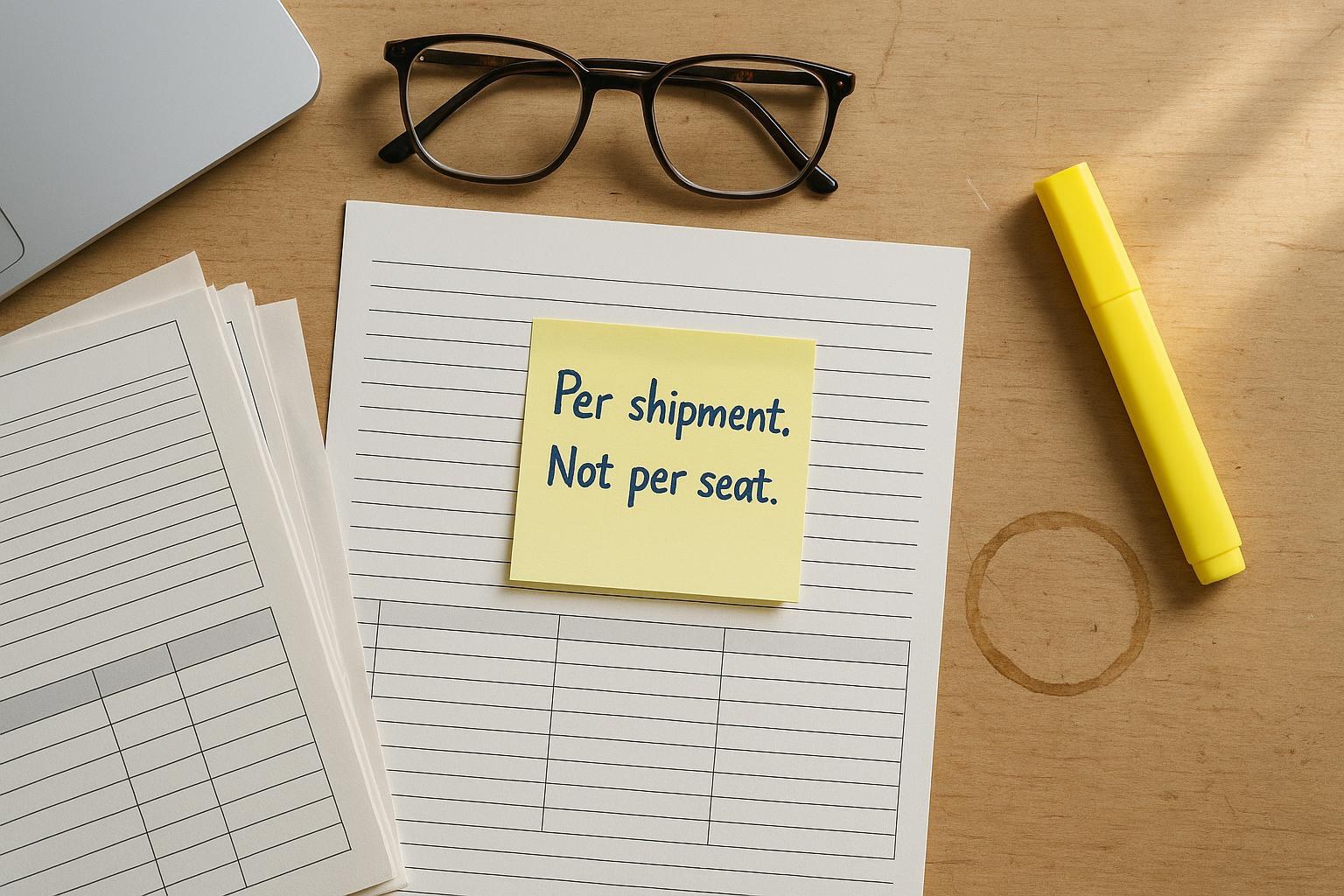
Value Packs: billed per shipment, not per seat
CargoWise's commercial model is called Value Packs. It's consumption-based: you're billed against transaction volume — shipments, jobs, whatever unit your contract defines as the metered event — rather than a flat fee per named user. That's a deliberate departure from the seat-license model most TMS and forwarding software still uses.
The practical effect: your CargoWise line item moves with your business, not your headcount. Win more freight, your bill goes up. Automate a process so fewer manual jobs get created in the system, your bill can go down — or at least grow slower than revenue. That's the pitch. Whether it plays out that way depends on how your ops team creates jobs in the system, because every job created is a billable event whether or not it ships.
What actually stacks into your invoice
Three layers typically compose the number you see:
| Layer | What it is | What drives it |
|---|---|---|
| Value Pack consumption | Per-shipment/per-job fee | Job volume created in CargoWise, not just completed shipments |
| Module licensing | eCustoms, warehousing, specific compliance modules | Which parts of the suite you've switched on |
| System fees | Automation and platform charges baked into the invoicing flow | Fixed per invoicing job, not negotiable per-transaction |
The first two are what get discussed in the sales call. The third — system fees like DOM-CWAF — rarely gets briefed at all, and it's the one that shows up on your first live invoice run as a surprise.
The fee nobody briefs you on: DOM-CWAF
DOM-CWAF is a system-generated automation fee that CargoWise adds on every invoicing job. It is not a module you opted into and not a line you can switch off in configuration. It's structural to how the platform processes invoicing, and it will appear on your buy side whether you plan for it or not.
Because it can't be disabled, the only real decision your finance team has is how it flows through to the customer-facing invoice. There are three strategies operators actually run:
Strategy 1 — Pass through as a disbursement
  Charge Code: DOM-CWAF mapped to a disbursement charge code
  Sell Rate: = Buy Rate (no markup, cost recovery only)
  Customer sees: a disbursement line on their invoice
  Risk: customer queries an unfamiliar line item — needs a one-line explanation on file

Strategy 2 — Absorb and filter from customer-facing data
  Charge Code: DOM-CWAF retained on buy side only
  Sell Rate: not mapped to any customer-facing charge code
  Reporting: excluded from customer statements and exported invoice templates
  Risk: cost sits on your P&L, invisible to sales when quoting margin

Strategy 3 — Zero the sell side
  Charge Code: DOM-CWAF present on both buy and sell
  Sell Rate: set to zero
  Customer sees: the line, at nil value
  Risk: transparent, but adds a zero-dollar line to every invoice — cosmetic clutter at volume
None of these are "correct" — they're a trade-off between transparency, invoice cleanliness, and who eats the cost. What matters is that someone in your finance team makes the choice deliberately, in your Charge Code Maintenance and finance rule setup, rather than discovering the default behaviour on a live customer invoice three months after go-live.
The arithmetic that's actually yours
Since I can't quote you a real per-shipment rate — WiseTech negotiates those per account — here's the formula. Pull your own numbers from your quote and your job-creation reports:
N = shipments/jobs created per month (not just completed — created)
R = your quoted per-shipment Value Pack rate
F = monthly module license fees (eCustoms, warehousing, etc.)
D = net DOM-CWAF exposure per month
    = (jobs invoiced × fee) if absorbed
    = 0 if passed through and recovered at cost

Monthly CargoWise cost ≈ (N × R) + F + D
Run this against your own job-creation report, not your shipment-completed report. If your ops team creates a job in CargoWise for every quote attempt, every amendment, every split shipment — N is bigger than your commercial team thinks, and it's the number driving your bill.
1-3-1: controlling per-shipment cost
The problem: N grows quietly. Nobody watches job-creation volume the way they watch revenue, so the Value Pack line grows faster than anyone budgeted for.
Three levers, in order of how fast they pay back:
- Cut job duplication before it happens. Amendments, re-keys, and split-job workarounds each create a new billable event. If your integration layer is generating extra jobs to work around a data gap, that's a direct line to your CargoWise bill — see /eadapter for how the eAdapter series handles job creation logic without the duplication.
- Decide your DOM-CWAF strategy on paper, not by default. Pick one of the three above, document it, and check it against actual invoices quarterly.
- Audit N and R before renewal, not during. Export twelve months of invoice history and job-creation counts before you sit down with WiseTech. A negotiated tier means nothing if you don't know your own volume.
The recommendation: before your next renewal conversation, pull your actual job-creation and invoice data out of CargoWise and run the formula above with your own numbers. /tools/cw-exporter will get you that export without a manual pull through the CargoWise UI.
Ready to automate your document processing?
Join freight forwarders saving hours every week with CargoMode.
Start for free